


|
To receive daily emails from Breaking Christian News to your inbox CLICK HERE
Virginia Dems Pass National Popular Vote Law that Experts Warn Is Unconstitutional"Virginia Democrats are waging political warfare against conservatives. National Popular Vote (NPV) is nothing more than a far-Left power grab to disenfranchise rural voters who overwhelmingly lean Republican." -Heritage Action for America Communications Director Stefani Buhajla
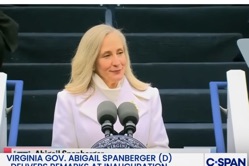
"The Agreement Among the States to Elect the President by National Popular Vote is enacted into law and entered into with all other jurisdictions legally joining therein," the new law states. "The chief election official of each member state shall designate the presidential slate with the largest national popular vote total as the 'national popular vote winner.' The presidential elector certifying official of each member state shall certify the appointment in that official's own state of the elector slate nominated in that state in association with the national popular vote winner." The controversial compact has already been joined by California (54 electoral votes), Colorado (10), Connecticut(7),Delaware(3),the District of Columbia (3),Hawaii (4), Illinois (19), Maine (4), Maryland (10), Massachusetts (11), Minnesota (10), New Mexico (5),New Jersey (14), New York (28), Oregon(8),Rhode Island(4), Vermont (3), and Washington (12). Including Virginia's 13 electoral votes, the NPVIC member states account for 222 electoral votes. The compact is slated to go into effect when the combined number of electoral votes of member states reaches 270, the number of electoral votes currently needed to win the White House. Until enough states have signed the compact to award the winner of the national popular vote the 270 electoral votes needed to win the presidency, the law remains dormant for the states that have signed it, potentially allaying legal challenges. The Republican Party of Virginia was quick to criticize Spanberger for signing the legislation, which was passed by the Democrat-controlled General Assembly. "Fake Moderate Spanberger just signed a bill to render Virginians' vote for president NULL AND VOID!" the state's GOP wrote in a social media post. The Republicans charged that the law "says that all of Virginia's Electoral College votes will go to the winner of the national popular vote—no matter who wins the popular vote in our Commonwealth. This is an unconstitutional assault on our democracy." In comments to The Washington Stand, Heritage Action for America Communications Director Stefani Buhajla said, "Virginia Democrats are waging political warfare against conservatives. National Popular Vote (NPV) is nothing more than a far-Left power grab to disenfranchise rural voters who overwhelmingly lean Republican." She continued, "Our Founders thoughtfully created the Electoral College at the Constitutional Convention to ensure equal representation among the states. The governor knows perfectly well that the NPV would surrender Virginia to California and New York mob rule—and she is glad to do it." Daniel H. Lowenstein, professor emeritus at the University of California Los Angeles (UCLA) Law School and director of the UCLA Center for the Liberal Arts and Free Institutions, told TWS that the NPVIC will likely be challenged as unconstitutional and would need congressional approval to succeed. "The most commonly raised constitutional question arises under the Interstate Compact Clause," he said. Found in Article I of the Constitution, the Interstate Compact Clause bars individual states from entering into "any Agreement or Compact with another State" without congressional approval. When Congress approves an agreement or compact between or among states, the agreement or compact becomes federal law. Stephen Mulligan, attorney advisor to the Library of Congress and lecturer in the Congressional Legal Education Forum, summarized, "As a result, interstate compacts have dual functions: They operate simultaneously as contracts between states and, once approved by Congress, as federal law." He explained, "The ability to form compacts with other governments is a defining characteristic of sovereignty, and the Compact Clause is meant to balance federal and state control over this power." Mulligan continued, "By allowing states to negotiate compacts but requiring congressional approval, the Compact Clause adapts the traditional compact-making power to the American constitutional system in which both the federal government and the states possess sovereign authority." Lowenstein suggested that the NPVIC is probably an interstate compact, adding, "If the NPVIC is a compact coming within the clause, that does not make it unconstitutional, but it means Congressional permission would be required." However, he continued, "I believe that a careful analysis of Article II shows that NPVIC is unconstitutional, with or without Congressional consent. Article II is often paraphrased as saying the state legislature has plenary (unlimited) power to determine how electors are chosen." He explained, "For most purposes that is accurate enough, but in the case of NPVIC a more precise reading is necessary." "The pertinent language in Article II says, 'Each State shall appoint, in such manner as the Legislature thereof may direct, a [specified] Number of electors...' Notice that this language does not say the electors may be chosen however the legislature provides," Lowenstein noted. "It says the legislature may determine how the state shall appoint electors. Thus, the only methods permitted are those in which the state is making the determination." He continued, "Historically there have been two such methods: selection by the state's voters and selection by the state legislature. The voters and the legislature may plausibly be said to represent the state. The same would probably be true of the governor, and conceivably some other statewide officer, such as the lieutenant governor or the attorney general." But, he warned, the "voters of other states cannot plausibly be said to represent the state. For example, I, as a resident of California, cannot plausibly be said to represent Maryland." Lowenstein concluded, "If this requirement is not recognized, then there would be nothing to stop the legislature from designating the United Nations, the King of England, or the Pope to name its electors, which would be absurd, as well as plainly contrary to the language of Article II." Subscribe for free to Breaking Christian News here S.A. McCarthy serves as a news writer at The Washington Stand. 
To receive daily emails from Breaking Christian News to your inbox CLICK HERE
Other Recent Articles from Breaking Christian News Researcher Convinced He's Found Noah's Ark Delivers a Message for Critics Roseanne Barr Is Coming Back With a New Family Series Security Bite: Apple's Latest Update, iOS 27, Lets Apps Ask Your iPhone If You're Being Scammed When Death is Dressed as a Cure Democrat Socialist Policies Would Cost $350K Per Household, Shorten Life Expectancy, Report Finds Texas County Takes Stand Against Sharia With Unanimous Vote New California Law Forces Churches to Provide 'Hate Speech' Training Massive 2,000-Year-Old Discovery Brings the World of Jesus to Life Remembering October 7th: Thousands of Christians Gather in Jerusalem to Fight 'Spiritual Battle' Pro-Lifers Visit Millions of Homes in Battleground States Ahead of Midterms If This Is True, CNN Just Dropped Some Huge Nicolás Maduro News A Satanic Invocation Opens Iowa City Council Meeting FBI Arrests 18-Year-Old Accused of Plotting ISIS Mall of America Attack in Minnesota 1,000 Christian Leaders Gather in Israel to Honor Oct 7 Victims, Stand With Survivors Christian Believers, Pastors, America Needs Your Biblical Voice Dr. Malone's Deep Dive into the Russian 'Plague' and What We Should Know |
Subscribe to
|

 [
[








All articles on this site and emails from BCN are copyrighted property of Breaking Christian News. Permission is given to link to, or share a BCN story if proper attribution is given to both the original writer and summarizer of the story. Breaking Christian News 2005-2019. All Rights Reserved.
Breaking Christian News is a division of Elijah List Publications, Inc. All Rights Reserved
Disclaimer: Articles and links, as well as the source articles linked to; do not necessarily reflect the opinion of Breaking Christian News.
| Home | Store | Subscribe | Facebook | Article Archive |