


|
To receive daily emails from Breaking Christian News to your inbox CLICK HERE
The Real Battle Isn't Iran vs. the World; It's Iran's People vs. the IRGC
[PJMedia.com] ...Those watching the fighting in and around Iran are beginning to recognize something the headlines routinely miss: The fault line that matters most isn't between Iran and the rest of the world. It's between the Islamic Revolutionary Guard Corps (IRGC) and the Iranian people themselves. (Screengrab image: via TikTok) For nearly five decades, the Islamic Republic has presented itself as the embodiment of Iran, as though opposition to the regime meant opposition to the nation. That's a convenient fiction, and millions of Iranians have spent years protesting, resisting, and sometimes dying in the streets to demonstrate the distinction. What we're watching now isn't another chapter in the familiar Iran-versus-foreign-powers story. It's an increasingly open struggle between a regime determined to preserve itself and a population that increasingly sees the chance to throw it off. Outside pressure has intensified that struggle, certainly, but let's be honest: It didn't create it. The roots of that struggle are inside Iran itself. Start with the body count. Protests broke out across the country in December 2025, driven by a collapsing economy—currency devaluation, water and electricity shortages, the basic government failures ordinary people feel long before diplomats do. The regime's answer wasn't negotiation. It was repression. By January, the crackdown had reportedly killed thousands, with the government itself acknowledging more than 3,000 deaths while insisting many of the dead were "terrorists." Independent reporting from the period put the toll at hundreds during particular phases of the unrest, with thousands more injured. Whatever number history settles on, the point doesn't change: Those people weren't killed on a battlefield against Israel or the United States. They were killed inside Iran, by the Iranian regime. The IRGC wasn't defending Iran from an invading army. It was defending itself from Iranians. And the anti-regime protests continue to get louder. Then there's a detail more revealing than the body count itself. Families retrieving relatives killed in the crackdown have reportedly been charged a so-called "bullet fee" before they're permitted to bury their dead—in some cases, they're pressured to sign documents falsely identifying the deceased as a Basij militiaman killed by "rioters." That's not a government protecting its citizens. It's a government protecting itself from them, and billing the survivors for the ammunition in the bargain. The Internet blackout tells the same story from a different angle. Iranian authorities shut down internet access for nearly five months, producing a 97% collapse in connectivity and isolating the population from the outside world and from each other. The official excuse was security—but security from whom? Washington wasn't responsible for the bulk of Iranians trying to reach each other. Israel wasn't responsible for families trying to learn whether their children were alive. The people who supposedly needed silencing were the people inside Iran. An authoritarian government doesn't shut down communications at that scale because it has nothing to hide, but because controlling information is itself a weapon, and here the weapon pointed inward. Then came the leadership vacuum. Ali Khamenei was killed in a February 28 strike, and his son Mojtaba was installed as Supreme Leader amid the chaos. But the succession didn't translate into a clean transfer of authority—the IRGC emerged with greater control over the machinery of state than the office of Supreme Leader itself. That matters because the Guard isn't just another military branch; it has built enormous political and economic power with its own institutional interests over the decades. The real question isn't who holds the title—it's who actually runs Iran. That question sharpened further when President Masoud Pezeshkian publicly apologized to the Iranian people for the crackdown—an extraordinary move for a sitting president, and a tell that the regime's problem isn't disagreement with foreigners but with its own population, one that increasingly appears to extend into the ruling structure itself. The IRGC keeps up the pretense of there being a civilian government because it needs that pretense to hide behind.
This may explain an IRGC commander's line describing the Iranian people as "our atom bomb"—meant as a boast about the regime's ultimate strength, but carrying an uncomfortable irony now. If the people are the regime's real source of strength, what happens once those people stop believing in it, as seems to have happened? A government can survive military defeat, sanctions, and diplomatic isolation. What it will in no way survive is its own population concluding it has no legitimate claim to their loyalty. The IRGC itself is not united. It's often described as a single disciplined organism with one mind. It probably isn't. Foreign Affairs argues one key fault line inside the Guard runs generational—senior commanders forged in the Iran-Iraq War of the 1980s versus younger, mid-ranking officers for whom the revolutionary mythology carries far less weight. That's not just sociology. An authoritarian system depends on its security services staying loyal to the system itself; once those officers start asking whether they're protecting the country or protecting a ruling class, the calculus changes. And if the IRGC fractures, the question stops being whether the regime falls and becomes what replaces it—since the collapse of one authoritarian structure has a long history of simply producing another. I suggest that's already happening. And look, let's stop confusing Iran with the Islamic Republic. Iran is a country. The Islamic Republic is a political system. The IRGC is the institution that has become one of that system's principal guardians. Those are three different things, and the distinction matters, because millions of Iranians have spent years, and many gave their lives, demonstrating that they don't regard the Islamic Republic as synonymous with their country. The rift between them is getting larger and more out of control even as you read this. So the next time somebody frames this entirely as America versus Iran, or the West versus a defiant Islamic Republic standing against foreign pressure, point them to the bullet fee. Point them to the blackout. Point them to the families burying people killed by their own government, and the president apologizing to his own people for what the IRGC did to them. Point them to the polling. The war that matters most here isn't being fought across an international border, and it's not even about oil at its root. The Strait of Hormuz is a sideshow, being animated by the regime's need for money to keep the Iranian people in line. The real battle is being fought in the streets of Iran, between a regime that has spent nearly half a century demanding its citizens' loyalty and a population that increasingly refuses to give it. The question isn't whether Iran survives. Iran will survive. It's too large not to. The question is whether the Islamic Republic, and the IRGC that has spent decades enforcing it, will. We had better hope they don't. Understand a fine point here: This is not regime change from outside. This is the Iranian people rising up and dealing with it... Subscribe for free to Breaking Christian News here Read this article in its entirety Here. 
To receive daily emails from Breaking Christian News to your inbox CLICK HERE
Other Recent Articles from Breaking Christian News Signs of Spiritual Awakening? 800,000 Gather in Secular France for Historic Mass Nebraska City Council Changes Homeschool Hiring Policy after Enormous Public Outcry Hilton vs. Becerra: Top 3 Moments from the California Governor Debate (Videos) GDP Revised Up for Both 1st and 2nd Quarters, Inflation Measures Lowered True Colors: Senate Dems Block Congressional Insider Trading Ban from Becoming Law The Real Battle Isn't Iran vs. the World; It's Iran's People vs. the IRGC Israel Celebrates Return of Heroes, Passengers from Flight 1073; a Midair 'Miracle' Netflix's Narnia is an Attack on Aslan's Christ Figure Report: Churchgoing Couples Have Highest Rate of Marital Satisfaction Senator's Roundtable Spotlights COVID Patients' Horrific battles over Medical Care [Video] Tech Leaders Agree to 'Self-Police' AI, Trump Renames AI 'Super Intelligence' 'Effectively Sharia Law': Newsom Signs Law Prioritizing Muslim State Holidays US Ends 12-year Anti-ISIS Mission in Iraq 'Totally Demonic': Jonathan Cahn Says He Was Attacked by Viral Duct-Taped Man on Plane Nebraska City Council to Vote on Reversing Anti-Homeschool Job Policy WATCH: America.gov Unveiled to Put the Entire Federal Government in One Website Border Patrol Puts Illegal Alien Caravan on Notice Lindsay Clancy Holdout Juror Refocuses on the Murdered Children as New Trial Starts (Video) |
Subscribe to
|


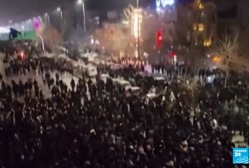 Seven out of ten is not a fringe movement. A recent








All articles on this site and emails from BCN are copyrighted property of Breaking Christian News. Permission is given to link to, or share a BCN story if proper attribution is given to both the original writer and summarizer of the story. Breaking Christian News 2005-2019. All Rights Reserved.
Breaking Christian News is a division of Elijah List Publications, Inc. All Rights Reserved
Disclaimer: Articles and links, as well as the source articles linked to; do not necessarily reflect the opinion of Breaking Christian News.
| Home | Store | Subscribe | Facebook | Article Archive |