
Trump's Saudi Nuclear Deal Could Remake the Middle East (Video)
Rod D. Martin : Aug 7, 2026
RodMartin.org
By tying American-built reactors to the Abraham Accords and a general peace, Trump is enriching US industry, lowering oil prices, isolating Iran, and making peace more profitable than war.
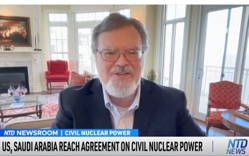 [RodMartin.org] I appeared on NTD Newsroom with Don Ma to go in-depth on the US–Saudi nuclear deal, and why it's about far more than energy. By tying American-built reactors to normalization with Israel, President Trump is encouraging regional peace while increasing Saudi oil exports (and thus lowering prices), enriching US industry, reducing proliferation risks, and deepening American influence over the most important countries in the region. It is the fulfillment of Eisenhower's dream of "Atoms For Peace". (Screengrab image: via NTD News)
We also discussed Palestinian statehood, Crown Prince Mohammed bin Salman, the Houthi threat, and Trump's broader "Commerce Not Chaos" strategy for making peace more profitable than war.
It's 12 minutes that quickly explain this incredibly complex issue. Watch the interview HERE, and pass it along!
Here's our full discussion:
Don Ma: The United States and Saudi Arabia are signing a landmark peace deal—a peaceful nuclear cooperation agreement, to be exact. Joining us now to discuss this is Rod Martin, geopolitical analyst and founder and CEO of Martin Capital.
Rod, good afternoon. Always great to have you on the show. President Trump is giving Saudi Arabia a civilian nuclear program, and in return, he's asking the Saudis to normalize relations with Israel. What do you think about this deal?
Rod D. Martin: This is really great, and the key word in that is "give." We are giving them permission. We are providing them the technology and equipment. We are going to help them. But we're not going to do it for free.
The president is a savvy operator, and this deal ensures that only American companies will be providing the actual construction and the actual nuclear technology. That's a big deal because Saudi Arabia has options. There's no reason they couldn't go to the Chinese. There's no reason they couldn't go to the Russians. In a pinch, they could go to Pakistan, with whom they now have a formal defense agreement.
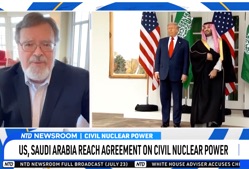 There are options in the world, and this president is committed to American industry leading wherever it possibly can. We're going to help them build some civilian reactors. There's no enrichment on the table. That's been bandied about by the media for the last couple of days. Enrichment is almost certainly not going to happen. (Screengrab image: via NTD News)
But this new contingency—this requirement that, for the deal to go ahead, the Saudis have to join the Abraham Accords—is actually really encouraging. Again, it's another example of Trump's "Commerce Not Chaos" diplomacy. It's also the fulfillment of Eisenhower's dream of "Atoms For Peace".
It is just stupid for Saudi Arabia to still technically be at war with a country with which it engaged in multiple levels of defense cooperation, even intelligence cooperation. It's time to formalize the peace and move the Middle East in the right direction.
These nuclear plants will also help because they'll allow Saudi Arabia to export more oil instead of burning it. That will bring down global oil prices, especially after the UAE's departure from OPEC.
Nothing matters more than educating the next generation with the values we cherish. The Herzog Foundation is making that possible. Learn more here.
Palestinian Statehood and Saudi Priorities
Don Ma: What do you say to the issue of Palestinian statehood? I don't know if Saudi Arabia is going to maintain its position that normalization with Israel requires a pathway to Palestinian statehood. Is that going to be an obstacle?
Rod D. Martin: Almost certainly. It has been so far. But I think the Saudis really want nuclear plants, and I don't blame them. I want nuclear plants in the United States too.
If you want to export oil and gas, you need another way to produce power. It's just a no-brainer.
Twenty years ago, you constantly heard people on both the right and the left saying Iran had no need for a nuclear reactor. Well, yes, they actually do. They're an oil exporter. They need civilian nuclear power to avoid burning what they'd otherwise export.
What they don't need is what they actually built, which is almost entirely a weapons program.
Because the United States will be stewarding this with the Saudis, we have reasonable guarantees that the Saudis are never going to be able to use what we build for them to build nuclear weapons.
We have a lot of people saying, "Oh, this will start an arms race in the region." No, it won't. This is not the first Middle Eastern country with nuclear power. You have nuclear reactors coming online in Turkey and Egypt. You have an actual operating civilian plant in the UAE, currently generating 25 percent of that country's electricity. And, of course, then you have Iran's Bushehr plant.
"Significant Step": UAE Completes Arab World's First Nuclear Power Plant
The UAE's Barakah Nuclear Energy Plant, the Arab world's first such installation, which produces 25 percent of the country's electricity, roughly equal to all electrical consumption in the entirety of New Zealand.
This deal is a good step forward. I think we're going to be able to get past the Palestinian issue because, now that we have the Board of Peace and the surrender of Hamas, we have everybody kind of on the same page there. I think there's a decent chance that MBS, whose generation is not as committed to the Palestinian cause as its elders, may be able to take the lead and see this through to completion.
Energy, American Industry, and a Generational Shift
Don Ma: It's entirely possible, as you suggested, that their desire for a nuclear power plant is stronger than their concern over the Palestinian issue. Maybe Saudi Arabia just needs the proper incentive, and maybe this could be it.
But you said earlier that Saudi Arabia has options, like China, for example, for nuclear power plants. Do you think it would have been only a matter of time, if the United States didn't make this deal, before Saudi Arabia pursued nuclear power anyway, potentially with Russia or China?
Rod D. Martin: Or both. Absolutely. They're going to do this. It's a no-brainer.
Again, if you want to sell oil and gas, you don't want to be burning it unless you absolutely have to. It doesn't make sense to be using your own supply. It's just crazy. Russia, which until recently had long been the world's biggest oil producer, has an extensive complex of nuclear power plants for exactly this reason.
So to the degree that these countries can diversify their power mix, they are richer. Their energy is cheaper. They have a long-term power source that doesn't reduce their ability to earn foreign currency from exports. It's just good all around.
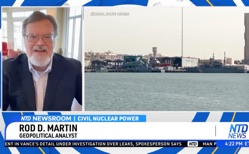 It's good for us, too. Again, we have a significant nuclear industry in this country that is now going to get all these deals. The deal is exclusive. Nobody gets to play in this market except US companies. That's a huge win for Trump's trade policy. (Screengrab image: via NTD News)
We'll see on the generational issue. Once again, MBS is the crown prince. His father, the king, and indeed the king's entire age group, are really committed to the idea of Palestinian statehood. The younger generation really isn't, not to the same degree. They understand the realities on the ground.
The fact is that none of the Arab countries will allow Palestinians to move into their countries anymore, because doing so inevitably brings terrorism and attempted coups. The Palestinians moved into Jordan after the Six-Day War and immediately tried to overthrow their host government. They moved into Lebanon after they got kicked out of Jordan and immediately started the Lebanese Civil War. Nobody wants to deal with that.
MBS's generation wants a peaceful solution. I don't know if that's going to include a Palestinian state, but my guess is that, if there is one, it will exist in federation with Israel, with internal autonomy but some overarching management of things that guarantees Israeli security and the security of its neighbors.
Egypt built an enormous wall between itself and Gaza, something it does not have between itself and Israel. There's a reason for that... Subscribe for free to Breaking Christian News here
Continue reading, and watch the video Here.
(Reprinted with permission)