
Trump and Xi Are Meeting about AI: Christians Should Pay Attention
Robert Maginnis-Commentary : May 12, 2026
The Washington Stand
Christians should engage with this at a deeper level than geopolitics. What the Chinese Communist Party is constructing is not merely an efficient governance tool. It reflects a vision of humanity in which people are data to be monitored, predicted, and managed—a vision that stands in direct opposition to the Biblical account of the human person. ... Technological power divorced from moral wisdom is dangerous for whoever holds it.
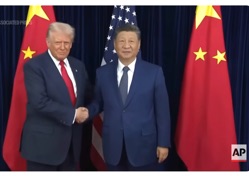 [WashingtonStand.com] When President Donald Trump arrives in Beijing this week for summit talks with Chinese President Xi Jinping, the announced agenda—trade, Taiwan, Iran, rare earth minerals—will dominate the headlines. But the contest that will most shape the world our children and grandchildren inherit is unlikely to receive a press conference of its own: artificial intelligence. (Screengrab image: via AP)
Every major power calculation between Washington and Beijing now runs through AI. The nation that leads in this technology may ultimately write the rules, values, and assumptions of the 21st century—determining who controls information, how militaries fight, and what logic gets embedded in the digital infrastructure of the world.
For years, American policymakers assumed the United States held a commanding lead. A recent National Review analysis argues that confidence is dangerously misplaced. US export controls intended to slow China's AI development may have produced the opposite effect—forcing Beijing to innovate independently and build a more self-sufficient technological base. Chinese firms are now producing advanced AI chips, software ecosystems, and open-source models capable of competing with America's best systems at dramatically lower cost. Global markets, the analysis warns, often choose what is cheaper and "good enough" over what is technically superior.
The numbers are striking. DeepSeek's V4 open-source model approaches the performance of top American systems while operating at a fraction of the cost—and was specifically optimized to run on Chinese hardware. Huawei's Ascend 950 chip, once considered a distant second to Nvidia's best processors, now matches the performance of Nvidia's H200 and has drawn major procurement orders from ByteDance, Tencent, and Alibaba. A technology the West assumed it had effectively contained is reemerging as a genuine competitor in the global AI marketplace.
In my book "The New AI Cold War," I argued that artificial intelligence would become the decisive strategic terrain of the 21st century— displacing oil, manufacturing, and even nuclear capability as the primary driver of global power. That argument is no longer theoretical. It is unfolding in Beijing this week.
More than an Economic Contest
The challenge is not merely technological. Beijing is not building better chatbots. The Chinese Communist Party is constructing an AI ecosystem tightly fused with state power—and that ecosystem is already being deployed against human beings. Facial recognition, social scoring, predictive policing, and digital population control are operational today. Human rights investigators have documented extensively how AI-enabled surveillance has been used against ethnic and religious minorities in Xinjiang, where Uyghur Muslims face biometric tracking, mandatory DNA collection, and algorithmic detention triggers based on religious practice.
Technologies shaped inside authoritarian systems carry the assumptions of those systems. When AI platforms built on those assumptions spread across developing nations because they are cheaper and more accessible, they carry their embedded values with them—shaping who gets surveilled, whose speech is flagged, whose beliefs are treated as threats to public order.
Christians should engage with this at a deeper level than geopolitics. What the Chinese Communist Party is constructing is not merely an efficient governance tool. It reflects a vision of humanity in which people are data to be monitored, predicted, and managed—a vision that stands in direct opposition to the Biblical account of the human person. Scripture frames the matter plainly. As Proverbs 29:2 puts it: "When the righteous increase, the people rejoice, but when the wicked rule, the people groan." The spread of AI built on authoritarian assumptions is not a distant abstraction. It is a question about what kind of governance will shape the ordinary lives of billions in the decades ahead.
A Competition America Cannot Win by Engineering Alone
Nor is this only a threat coming from abroad. AI already shapes what billions of people see online each day, what children are taught, and which ideas are amplified or suppressed. As these systems grow more capable, the risk of centralized manipulation grows alongside them—regardless of which country controls them. Technological power divorced from moral wisdom is dangerous for whoever holds it.
Beijing is rapidly integrating AI into military systems, intelligence analysis, cyber operations, and autonomous battlefield platforms. Senior US officials ahead of this summit have expressed increasing concern that AI superiority may determine the outcome of future conflicts, and the two sides are expected to explore establishing formal channels of communication on AI risks—the first significant diplomatic engagement on the issue. That conversation is necessary. But America's ability to lead it depends on whether we still hold the moral clarity that distinguishes free societies from systems that treat human beings as manageable data.
America cannot prevail in this competition through engineering and economics alone. Maintaining technological leadership matters enormously—but leadership that lacks a coherent moral framework for the uses of that technology is a different kind of vulnerability. The United States must preserve the foundations that distinguish free societies from the authoritarian model Beijing is exporting.
The Responsibility Christians Cannot Outsource
 That is where Christians carry a weight in this conversation that extends well beyond electoral politics. Believers should advocate for AI policies that protect human dignity, religious liberty, parental rights, free speech, and moral accountability. The work begins closer to home: in how parents engage with the AI tools already shaping their children's formation, in how pastors equip congregations to evaluate a technology that increasingly intermediates between people and truth, and in how Christian educators hold the conviction that wisdom, conscience, and moral judgment cannot be trained into a machine, however sophisticated. (Image: Created by Grok AI)
The summit this week is a visible marker in a contest that will define the trajectory of the century. What hangs in the balance is not primarily a trade deal or a diplomatic communiqué. It is the question of whether the AI-driven future will be one in which human beings are governed in accordance with their God-given dignity—or reduced to subjects of the kind of rule Proverbs warns makes the people groan. Christians who hold that distinction clearly are not spectators in this contest. They are its most necessary participants. Subscribe for free to Breaking Christian News here
Robert Maginnis is a retired US Army lieutenant colonel, senior fellow for National Security at Family Research Council, and the author of 14 books. His latest, "The New AI Cold War," releases in April 2026.