
Drones, Data, and the Soldiers Rewriting Warfare: Inside the Army's New Approach
Caitlin Burke : Mar 24, 2026
CBN News
"The person encountering the problem at that lowest level is identifying that problem, coming up with a solution, and then is empowered to actually produce that solution." -Captain William Langley
 [CBN News] Analysts see Operation Epic Fury as a real-time look at a new era of warfare. It displays a wide range of capabilities, from missiles and air defense to AI, drones, and cyber, all working together to accomplish the mission. (Screengrab image: via CBN News)
Even with the Joint Force still fighting in the Middle East, here at home, innovation and preparation continue for the next battle.
For the Army, many of the solutions needed to stay ahead of the curve are being built by the soldiers who will use them—especially when it comes to drones.
"The Army said, 'Hey, you guys go figure it out. You're the experts," Chief Warrant Officer Robert Reed told CBN News.
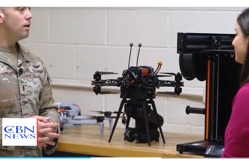
Warrant Officer Reed leads the Pennsylvania National Guard's drone training and innovation facility out of Fort Indiantown Gap.
Watch the CBN News video report Here
He and his team recently took the top prize for innovation in the Army's first drone war-fighting competition.
"I have such an amazing team that these guys took hold of it, and really, you know, trained themselves for lack of a better way to say it...And what they do, we can provide them a problem set, just like this competition, and they just get after it. And it's amazing to watch them every day, and their skills, and a lot of that is, you know, a younger generation...I sound like an old guy, I guess, but the younger generation understanding the software and the coding and the data and everything behind it, and it's amazing to be able to watch them take that and put it into an applicable sense for the Army," Reed explained.
First Lieutenant Ryan Giallonardo is also a part of that winning team. As a traditional Guardsman, he works a civilian job, specializing in software development and data science, and one weekend a month, plus two weeks each year, he puts those skills to use for the Army. His expertise was integral in their recent competition.
"To talk a little bit about the specific components that I developed, it was in artificial intelligence, machine learning, object detection model. So the idea was to be able to identify other downed drones, such that we could secure them or bring them to a different location, with the hope that eventually we would expand that to other types of objects as well," Giallonardo told CBN News.
The team will now partner with the Army Research Lab to take their winning innovation even further.
"They're going to help us refine it, grow it, and develop it, and scale it to other platforms and other ways to utilize it," Reed explained.
This kind of soldier-driven innovation isn't limited to the National Guard. Across the Army, units are encouraged to test new technology and develop solutions in real time.
At Fort Stewart, GA, soldiers with the 2nd Armored Brigade Combat Team test drones, adapting them for the realities of combat.
"Once we received our squad-level drones...Soldiers took the idea of being able to expand their use across our own battle space, and to find new ways on how they can better implement them, how they can improve them, and then make them more useful to the user...at the soldier level," Captain Jonathon Price, with the 3rd Infantry Division, told CBN News.
One problem that was quickly identified during training involved how easily the enemy can detect drone pilots.
In order to operate the drone, they had to step outside their armored vehicles, and the glow of their control screen could possibly give away their position.
Sergeant First Class Scott Kibby saw an opportunity to fix that by reconfiguring a periscope traditionally attached to the vehicle.
"We were out on a mission, out training, and we had to pull the periscope for some reason...I saw that there was a hole...So I had my soldier hold the antennas up for the drone. He was able to get signal with the drone from inside. So that's where we came up with everything to replace the periscope with a box that the antennas can go through," Sgt. Kibby explained.
He and Price took the idea to the base innovation center, where a team quickly developed a 3D printed insert. The result: problem to solution in just two weeks. The fix was implemented with the team still in the field.
"The ability to be able to keep more soldiers out of the fight but still being able to do the same job and have that protection for us is significant," Kibby told CBN News.
The 2nd Armored Brigade has fielded 150 first-person viewer, small and medium drones – an effort headed up by Captain William Langley.
"Before, you might have a platoon in a brigade that is using UAS to do reconnaissance. Now we have the capability of giving every platoon throughout the entire brigade a drone," Cpt. Langley said.
As one of the first armored brigades provided this opportunity, the lessons learned in tactics and planning will be spread across the rest of the Army.
"It allows soldiers at the lowest level to have an impact on the future of the Army," Langley explained.
From Pennsylvania to Georgia, soldiers are experimenting, adapting, and building solutions faster than past systems ever allowed.
"The person encountering the problem at that lowest level is identifying that problem, coming up with a solution, and then is empowered to actually produce that solution," Langley said.
"It's not really how the Army has worked traditionally, right? Your kind of like top-down approach, and being able to see that go bottom-up and really, you know, see what my team has put into this, and see that out there is just an amazing thing that's really cool," said Warrant Officer Reed.
As drones become a permanent feature of modern warfare, the Army is learning that innovation doesn't always come from the top. Sometimes it starts with a young soldier who sees a problem and decides to fix it. Subscribe for free to Breaking Christian News here
Caitlin Burke serves as National Security Correspondent and a general assignment reporter for CBN News.