
North Carolina, Texas Kick Off Contentious Midterm Primaries
S.A. McCarthy : Mar 4, 2026
The Washington Stand
Tuesday night saw primaries conducted for 61 different roles, including House and Senate seats and governorships. Here are the most significant results.
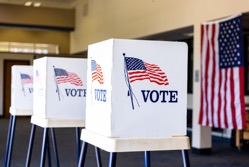 [WashingtonStand.com] Battle lines are being drawn in the fight to control Congress. Tuesday night, voters in Arkansas, North Carolina, and Texas went to the polls to cast their ballots in the Republican and Democratic primaries that will ultimately shape November's midterm elections. (Image: iStock-Adam Kaz)
At stake: control of the US House of Representatives, where Republicans currently hold a narrow majority of 218 seats, against Democrats' 214, with three vacancies. Those vacant seats represent California's first congressional district, previously held by the late Doug LaMalfa (R); Georgia's 14th, vacated by former Rep. Marjorie Taylor Greene (R); and New Jersey's 11th, vacated by the Garden State's new governor, Mikie Sherrill (D). LaMalfa's and Greene's former seats are expected to be filled by Republicans, giving the GOP a total of 220 seats, and Sherrill's by a Democrat, ultimately meaning that Democrats must maintain their current seats and flip only three seats in order to take the House from Republican control.
The US Senate poses a more significant challenge for Democrats. While 35 Senate seats will be up for grabs in November, including special elections in Florida and Ohio, Democrats will be defending 13 seats, including several in swing states that President Donald Trump won in 2024. Republicans, meanwhile, will be defending 22 seats, many of which are considered safe. In order for Democrats to topple the current GOP majority in the Senate, they will need to not only maintain their current seats but flip at least four Republican-held seats.
Tuesday night saw primaries conducted for 61 different roles, including House and Senate seats and governorships. Here are the most significant results.
Arkansas
Voters in Arkansas saw relatively few surprises but did see some familiar faces. Incumbent Governor Sarah Huckabee Sander (R) won renomination unchallenged, while incumbent Senator Tom Cotton (R) fended off two primary challengers—businesswoman and Baptist evangelist Micah Ashby and Arkansas State Police Officer Jeb Little— and took over 80% of the Republican primary vote. Republican incumbents went unchallenged in the state's first (Rep. Rick Crawford), third (Rep. Steve Womack), and fourth (Rep. Bruce Westerman) congressional districts, but incumbent Republican Rep. French Hill won a primary challenge inArkansas'second congressional district.
Notably, Arkansas has not elected a Democrat to a statewide office in nearly two decades.
North Carolina
Redistricting has been a focal point of the 2026 midterms, following Trump's call-to-arms urging red states to redraw congressional district maps to favor the GOP. North Carolina's first congressional district may demonstrate the impact of redistricting on the midterms. Currently held by Democrat Rep. Don Davis, the first district was redrawn by the state legislature in 2023, giving Republican candidates a slim advantage in a district that no Republican has represented since 1883. Davis narrowly won reelection in 2024, after the redrawn maps took effect, with less than 50% of the vote against Republican challenger Laurie Buckhout (47.8%), who was nominated Tuesday to once again take on Davis on behalf of Republicans. The first district is considered the most competitive in North Carolina. Voters elected Trump in 2024.
The only race "too close to call" in North Carolina is the Democratic primary for the fourth congressional district, where incumbent Rep. Valerie Foushee (D) is facing a challenge from the Left. In the past, Foushee has benefited from significant AIPAC and pro-Israel political action committee (PAC) spending, but has pledged not to accept AIPAC funding in light of the Democratic Party's sharp pivot against Israel in favor of Palestine. However, the congresswoman has accepted at least $600,000 in donations from Article One PAC, linked to both AIPAC and AIPAC mega-donor and billionaire Robert Granieri, which Canadian-born Muslim and primary challenger Nida Allam (D) has used in attacking Foushee. As of early Wednesday morning, Foushee is leading Allam in the primary by a mere 1,202 votes, roughly equivalent to one percentage point.
Perhaps the most interesting North Carolina race to watch in November will be the battle for a Senate seat representing the state. Former Republican National Committee (RNC) chairman Michael Whatley, a staunch Trump ally known for aggressively litigating election integrity cases ahead of and during the 2024 general election, handily won the Republican nomination for the Senate seat with nearly two thirds of the vote, outperforming six challengers, including US Navy veteran, former federal prosecutor, and author Don Brown.
The Democratic nomination was secured by former North Carolina attorney general and Governor Roy Cooper, who won 92% of the vote against five lesser-known challengers. Whatley has been endorsed by Trump and largely aligns with the president politically; he played a key role in gutting long-standing pro-life language from the GOP's 2024 platform. Cooper, meanwhile, is and has been an ardent abortion advocate, even vetoing legislation during his tenure as governor that would have penalized doctors for leaving babies who survive abortions to die after being delivered.
Texas
The Lone Star State is known for its heat, and Tuesday's primaries were heated. Perhaps the most closely-watched primaries were the Republican and Democratic Senate battles. Incumbent Senator John Cornyn (R), who has held a Senate seat for nearly 25 years after having served as both a Texas Supreme Court judge and Texas attorney general, faced a contentious primary challenge from current Texas Attorney General Ken Paxton (R), who has cast himself as a Trump-aligned candidate taking on what Paxton frames as the GOP establishment. Neither man won more than 50% of the vote: as of early Wednesday morning, Cornyn is in the lead with 41.9% of the vote, while Paxton is close behind with 40.7%. The election will now go to a runoff between Cornyn and Paxton. US Rep. Wesley Hunt (R) finished third, with roughly 13% of the vote. A self-described "America First" candidate who has also framed Cornyn as a too-moderate establishment fixture, most of Hunt's voters are expected to back Paxton in the runoff.
On the Democratic side, state representative James Talarico defeated US Rep. Jasmine Crockett for the party's nomination. While Talarico is considered a rising star in the Texas Democratic Party, Crockett has captured national attention for her blunt, forceful criticism of Trump and opposition to his administration. Both Talarico and Crockett are considered progressive populists and support abortion, the LGBT agenda, including gender transition procedures for minors, and packing the US Supreme Court, among other far-left policies.
While incumbents in Texas are rarely unseated, state representative Steve Toth (R) successfully defeated incumbent US Rep. Dan Crenshaw (R) for the GOP nomination to represent the state's second congressional district, just north of Houston. Toth campaigned from Crenshaw's right, amplifying accusations that the incumbent congressman is a RINO (Republican in Name Only) due to Crenshaw's criticism of 2020 election integrity concerns, broad support for foreign funding to nations like Ukraine, hawkish foreign policy frequently labeled neoconservatism, and other issues.
Less surprising was Governor Greg Abbott (R) winning his party's nomination for the gubernatorial race—again. A former Texas Supreme Court judge and state attorney general, Abbott has been in office for over a decade, distinguishing himself as a close ally to Trump and overseeing the introduction and enforcement of numerous pro-life laws in his state. The Democratic gubernatorial primary was handily won by state representative Gina Hinojosa. A pro-immigration advocate, Hinojosa was one of the 50 Texas House members who fled the state to prevent a quorum and block Republicans from redrawing congressional districts. Subscribe for free to Breaking Christian News here
S.A. McCarthy serves as a news writer at The Washington Stand.