
Schumer Pushes Legislation to Shield pride Flag with US Flag-Level Protections
Sarah Holliday : Feb 18, 2026
The Washington Stand
"We already have a flag that represents everyone. It's called the American flag, and it stands alone." -Representative Claudia Tenney
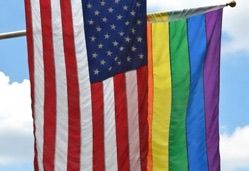 [WashingtonStand.com] In the wake of the Trump administration removing a massive pride flag from the Stonewall National Monument, Senate Minority Leader Chuck Schumer (D-NY) announced plans to propose a new piece of federal legislation—one that would give the Pride flag some of the same legal protections as the US flag, military service flags, and POW/MIA banners. (Image: Created by Grok AI)
The action follows a January 2026 directive from the Department of the Interior and National Park Service (NPS), which clarified longstanding policy by restricting "non-agency" flags on federal property managed by the NPS. This led to the removal of the pride flag from the Stonewall site — a location often described by activists as the "birthplace" of the modern gay rights movement. Schumer condemned the move, even referring to Stonewall as "sacred ground," stating that "Congress must act now to permanently protect the pride flag and what it stands for. Trump's hateful crusade must end."
Outraged activists and local leaders quickly responded by re-raising the pride flag at the Manhattan monument in direct defiance of the federal directive. If Schumer's proposed bill succeeds, it would designate the pride flag as congressionally authorized, potentially preventing future removals and allowing it to fly at Stonewall and possibly other sites. As Schumer argued, "The very core of American identity is liberty and justice for all—and that is what this legislation would protect: each national park's ability to make its own decision about what flag can be flown. Attempts to hurt New York and the LGBTQ community simply won't fly, but the Stonewall pride flag always will."
Yet, as some have pointed out, President Donald Trump has not explicitly singled out the Pride flag in public statements. Instead, his administration's policy—implemented via an NPS memorandum—aimed to ensure uniformity by limiting displays on federal property primarily to the US flag, with limited exceptions for agency flags, historical contexts, military flags, POW/MIA banners, or those of federally recognized tribes. This approach sought to prioritize national symbols and reduce what supporters view as divisive or extraneous displays on government land.
Rep. Claudia Tenney (R-NY) highlighted this perspective on X, posting: "We already have a flag that represents everyone. It's called the American flag, and it stands alone." Other voices echoed similar sentiments. Reverend Jordan Wells urged Christians to "stand for biblical truth" and criticized the proposed legislation, writing, "Democrats are obsessed with shoving this perversion and wickedness into our kids' lives and our culture. The LGBTQ community already has every right everyone else does, but that's not enough—they demand to force their ideology on us like a new religion. Meanwhile, these same Democrats never lift a finger for actual faith. Just a bunch of godless hypocrites pushing an agenda straight from the pit."
Albert Mohler, president of the Southern Baptist Theological Seminary, provided a biblical perspective on the controversy during a recent episode of "The Briefing." He framed the issue as "a battle over symbolism," noting, "Christians understand symbols are important, and the pride flag is a central symbol of the Gay pride movement." Mohler observed that the movement has permeated corporate America and culture broadly, but added that "the Trump administration's been pressing back on it, and there have been some incremental gains"— gains that could prove temporary under future administrations.
Mohler shifted focus to the word "pride" itself, stating, "We need to understand that ‘pride,' Biblically, is at the top of the list of the vices, not the virtues. And that is because ... there is the understanding that the most basic sin is pride." He traced this to Genesis 3, where Adam and Eve were tempted to "be as God," underscoring pride as "the most foundational sin."
"[L]et's confess something," Mohler continued. "We are all guilty of the sin of pride. Every single one of us." While Christians are called to humility, pride remains "blinding" and difficult to overcome. He contrasted secular claims of pride in identity with the Biblical view: "The honor and dignity that is due to every single human being [is] because we're made in the image of God. Not because of who we are, but because of who God is. ... And the most important thing we must do is make certain that we find no pride in doing what God has commanded us not to do."
Mohler described finding pride in "rebellion against the created order" as "a massive problem" that reveals deeper sin, with the pride flag serving as "a graphic symbol of that very problem." For Christians, he argued, "we should see the pride flag as a very clear indication of precisely the wrong kind of pride and the sinful dimension of pride."
In closing, Mohler pointed to the Gospel. "[A]s Believers," he said, "as people who know and love the Gospel of the Lord Jesus Christ ... every one of us in our own way has gone astray. Every one of us in one way or another has tried to plant a flag of arrogance against God and His holiness and righteousness and justice. Every one of us in our own way has sinned against God. That is not to say that everyone has committed a sin against creation order. It is to say all of us have sinned and fall short of the glory of God. Every single one of us has no hope but the Gospel of the Lord Jesus Christ."
Ultimately, he urged reflection: "Every time we see that flag, we need to be reminded not only of the moral crisis we face, but of the sin of pride and what it means and just be humbled by the reality of the phenomenon of sin and the insidiousness of pride, lest we also fall."
Sarah Holliday is a reporter at The Washington Stand. Subscribe for free to Breaking Christian News here