
Survey Shows Record American Support for Public Faith Sharing
Sarah Holliday : Jan 21, 2026
The Washington Stand
"This year's Index shows that Americans come together around our founding principles of religious toleration and pluralism. We see overwhelming levels of support for the freedom to pray, worship, choose and practice a religion freely." -Becket's Strategic Research Associate, Derringer Dick
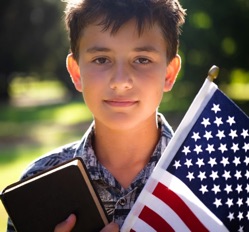 [WashingtonStand.com] Americans, particularly the younger generations, want to see more faith. Not merely in the home, not merely in places of worship, but in the public square. (Image: Created by Grok-AI)
In its seventh edition, the Becket Fund for Religious Liberty's 2025 Religious Freedom Index found 57% of surveyed Americans agree that religious freedom is "inherently public." Respondents believe faith should be able to be shared freely without consequence, which would entail spaces like schools, work, and social media.
The index also noted how religious freedom appears to be bringing Americans together. "This year," it read, "religious freedom made several trips to the Supreme Court—and many more to newspaper headlines. Litigation and newsworthiness can create the perception that religious liberty is a flashpoint in American culture. But our findings suggest the opposite is true: religious liberty is something that Americans can rally around, despite their other disagreements." At least "73% of Americans support parents being able to opt out of public school curriculum—up 10 points since 2021."
Concerning specific religious freedom cases, at least 65% of Americans supported "the Supreme Court's ruling that Catholic Charities should have the same tax exemption that other religious charities are granted." Additionally, "A solid majority of Americans (62%) supported the Supreme Court's decision in Mahmoud v. Taylor," which "acknowledged the vital right of parents to oversee the religious upbringing of their children—a right they ruled did not end at the classroom doors. The Supreme Court held that Montgomery County had to provide curriculum opt-outs for students. This year's Index results show that Americans agree with the court's common-sense decision."
The index annually takes into account how Americans view a number of categories related to religious liberty. Those categories include the following: Church & State, Religion in Society, Religion in Action, Religion & Policy, Religious Sharing, and Religious Pluralism. The higher the cumulative score, the stronger American support for religious freedom is overall. 2025's score reached a new all-time high of 71, marking a five-point increase from 2020.
Notably, in addition to supporting religious liberty at large, the survey also found that at least 47% of Americans believe Christian counselors have the right to guide children away from gender-confusion. In a similar vein, 58% believe bakers and cake artists (i.e., Jack Phillips) should not be forced into producing something that violates their conscience.
This survey comes at a tumultuous time in the realm of religious liberty. Starting abroad, the 2026 Open Doors World Watch List revealed that Christian persecution across the globe has only worsened. The report found that the total number of Christians killed for their faith increased by several hundred from the previous year. The number of Christians displaced from their homes amid persecution threats or taken into captivity has also increased—as have the number of church and Christian properties attacked.
Back stateside, however, where freedom of religion is embedded in the country's core principles, various forms of persecution and oppression have emerged. Last year saw the shooting at Church of the Annunciation in Minneapolis, the firebombing of Pennsylvania's Jewish Governor Josh Shapiro's home, the shooting of two Israeli embassy staffers outside of the Jewish Musuem in Washington DC, the shooting at Chapel of the Church of Latter Day Saints in Grand Blanc, and several other acts of arson, vandalism, and related attacks.
This past Sunday, as part of several weeks of anti-ICE protests stemming from Minnesota, Cities Church in St. Paul, Minneapolis, became the grounds of a rowdy protest. Agitators stormed the church in the middle of the worship service, yelling profanities, screaming political slogans, and allegedly referring to scared, crying children and their families as "privileged pigs." Reportedly, the church was targeted due to one if its pastors working for ICE. And yet, as the Department of Justice investigates the invasion, many have already regarded the scene as not only inappropriate and not protected by the First Amendment, but also a violation of the federal FACE Act.
A 2024 Family Research Council report highlighted an overall increase in hostility against US churches, identifying at least 1,384 acts of hostility toward churches between January 2018 and December 2024. The report outlines hundreds of cases involving vandalism, arson, bomb threats, and other attacks, with much of the rise attributed to growing ideological conflicts over issues such as abortion, LGBT ideology, and, more recently, immigration and deportation related policies.
Yet simultaneously, the Trump administration has taken several notable measures to promote religious liberty, such as establishing the White House Faith Office, signing executive orders aimed at combatting anti-Christian bias, and creating the Religious Liberty Commission. In July, President Donald Trump even issued a guidance encouraging federal employees to feel safe freely sharing their faith in the workplace. As Office of Personnel Management Director Scott Kupor said at the time, "Federal employees should never have to choose between their faith and their career."
Concerning the Becket survey, Becket's Strategic Research Associate, Derringer Dick, explained to The Washington Stand how its findings tie into the broader conversation regarding religious liberty. "This year's Index shows that Americans come together around our founding principles of religious toleration and pluralism," he said. "We see overwhelming levels of support for the freedom to pray, worship, choose and practice a religion freely." For example, the survey found that 94% of Americans desire the "freedom to practice" their religion "without facing discrimination or harm." Similarly, 96% want the "freedom to pray without fear of persecution."
According to Dick, the questions for each annual survey remain largely the same—only with some occasionally tailored to current events. As Dick explained, "When asked about matters that were recently before the Supreme Court, strong majorities of Americans supported upholding the rights of religious parents and protecting religious charities." But overall, when it came to religion's impact on voting, values, and daily life, the survey consistently showed high percentages of Americans [who] want freedom to express their religion as they choose. "[W]hen asked about religion's place in the public square," Dick re-emphasized, "Americans agreed that religion is a public matter, not a private one."
He concluded with a glimmer of optimism: "All of these heartening findings are proof that religious freedom, far from dividing Americans along religious, generational, or partisan lines, unifies us around the valuable belief that Americans of all faiths should be free to worship and live out their beliefs in our society." Subscribe for free to Breaking Christian News here
Sarah Holliday is a reporter at The Washington Stand.