92% of Venezuelans are 'Grateful' to Trump for Maduro Capture
Joshua Arnold : Jan 19, 2026
The Washington Stand
Venezuelans have not yet seen a marked improvement in their own lives. Yet they are still grateful to Trump for capturing Maduro, suggesting their praise is solely dependent on their loathing of Maduro.
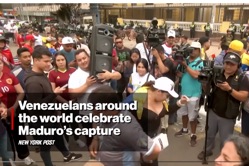 [WashingtonStand.com] Ordinary Venezuelans' opinion of America and of President Donald Trump are flying sky-high after a US raid captured Venezuelan dictator Nicolás Maduro. In a recent poll of 1,006 Venezuelans by the polling firm Encuestador Meganalisis, more than 90% said they were grateful to Donald Trump and wanted the United States to become Venezuela's principal ally and sole trade partner. (Screengrab image: via NY Post)
When asked in the Spanish-language poll, first reported by Breitbart, whether they were grateful to Donald Trump, 92.2% of Venezuelans surveyed said "yes," compared to 6.3% who said "no." The stunningly one-sided result (a ratio of nearly 15 to one), at a time when Trump's popularity is underwater in most domestic polls, speaks volumes about Maduro's unpopularity with ordinary Venezuelans.
For comparison, the most popular American in the fourth quarter of 2025 was Morgan Freeman, and even he only boasted an 88% approval rating, according to YouGov. Trump enjoys greater popularity among Venezuelans simply for taking out Maduro.
Nearly 3,000 years ago, King Solomon reflected that, "When the righteous increase, the people rejoice, but when the wicked rule, the people groan" (Proverbs 29:2). Venezuelan dictator Nicolás Maduro vividly illustrates this proverb. So hated was he by his own subjects that an overwhelming majority of them felt grateful to a foreign head of state whose military raided Maduro's compound in their own country and violently captured him.
Whatever residual goodwill Maduro may have enjoyed after suppressing dissent and suffocating the economy likely evaporated in 2024, when he stole an election in a ruling so obviously fraudulent that many other nations in the Americas refused to recognize him as a legitimate ruler.
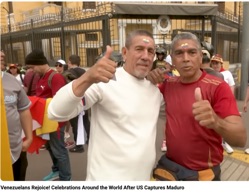 Venezuelans did not even restrict their overwhelming positive feelings for Trump alone. When asked, "Do you agree with the US becoming the principal ally and only provider of products for the Venezuelan state?" (Meganalisis' translation), a stunning 90.6% said "yes," while only 7.3% said "no." Venezuela's socialist regime has cut off trade relations with the US while improving its relationships with ideologically aligned countries like China and Cuba. Apparently, a super-majority of Venezuelans dislike this arrangement. (Screengrab image: via NY Post)
Even the remnants of Maduro's regime, led by his vice president, Delcy Rodriguez, have wasted very few tears on their previous boss and seem perfectly content to work with the American regime that captured him. Here was a boss who inspired no love among his subordinates. He controlled the government through fear. And, once he was arrested and taken to the US, he no longer inspired fear.
Yet Maduro's capture does not mean that Venezuelans are free—not by a long shot. In the same poll, 66.9% said Maduro's socialist party, known by Venezuela's distinctive socialist philosophy, "Chavismo," still governed the country, while only 14.1% said Venezuela was under the control of the United States.
Accordingly, 83.5% of respondents believed they could be detained for publicly criticizing Chavismo, although few of them trusted the party. When asked which Chavismo leader they trusted most, 90.9% of respondents answered, "none."
This makes Trump's popularity among Venezuelans even more striking. Venezuelans have not yet seen a marked improvement in their own lives. Yet they are still grateful to Trump for capturing Maduro, suggesting their praise is solely dependent on their loathing of Maduro.
The poll, like the Maduro raid, offers instructive lessons for Americans regarding the benefits and limitations of pinpoint raids on foreign dictators. On one hand, it now seems clear that removing a single dictator is insufficient to topple his entire power structure. Thus, it may not be an effective means of total regime change. But it could make an unreasonably conceited regime more open to American interests.
On the other hand, there seems to be little risk that raids sniping hated dictators will generate anger towards America in that country. If anything, a dictator's subjects may gladly welcome his removal, even if it does not directly bring them freedom.
These are important lessons to remember when America considers ways to help protestors in Iran and elsewhere obtain political freedom. Of course, the larger question is whether the US military should engage in surprise raids on foreign soil at all; that is a constitutional question which foreign opinion polls cannot answer. Subscribe for free to Breaking Christian News here
Joshua Arnold is a senior writer at The Washington Stand.